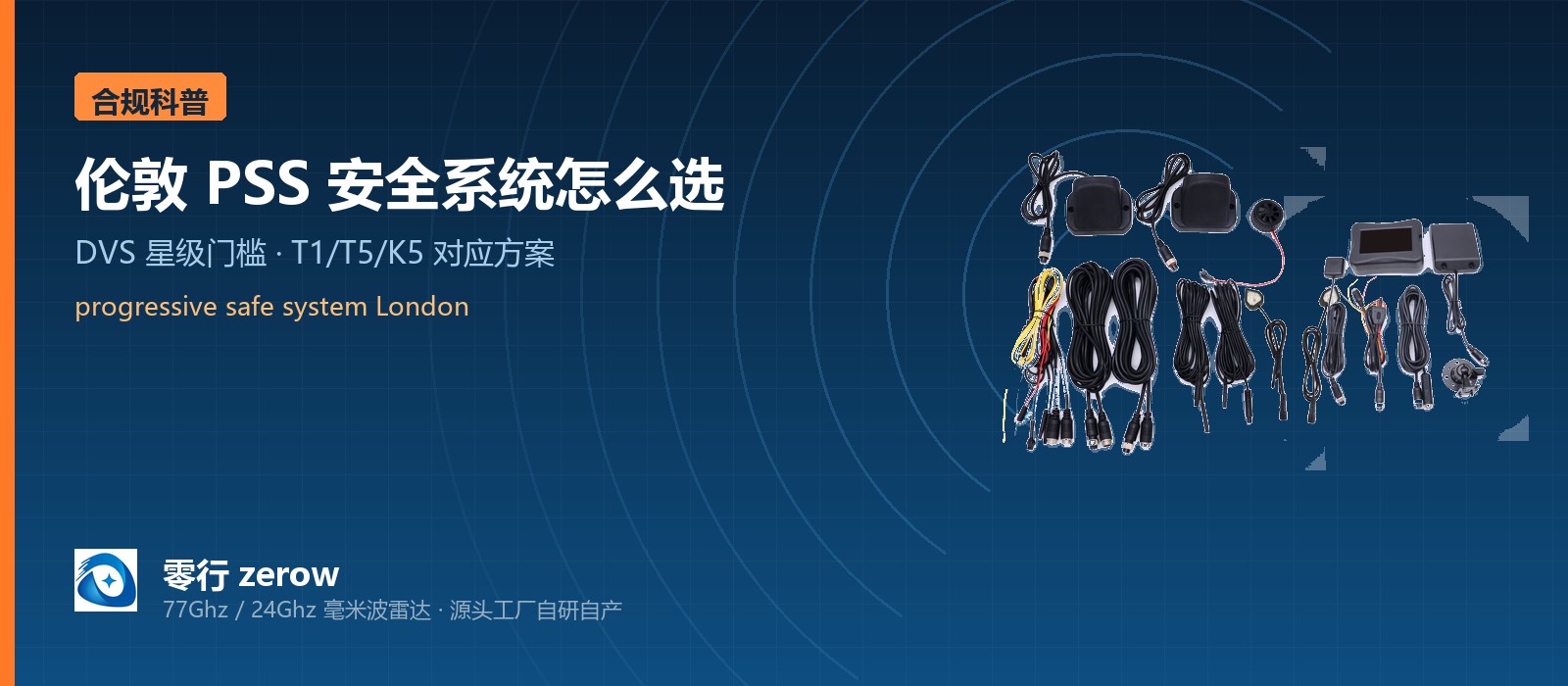
Direct vision compliance for lorries in London tightened on 28 October 2024. Transport for London rates an HGV from zero to five stars under the Direct Vision Standard, and from that date three stars became the threshold for an HGV Safety Permit. Vehicles at three stars or above can apply directly. Vehicles at zero, one or two stars, and vehicles with no rating at all, must first be fitted with a Progressive Safe System. The permit itself is free, but operating without one, or breaching its conditions, can bring a penalty charge notice of up to 550 pounds, halved if paid within 14 days and issued for each day of operation.
The progressive safe system London procurement line is therefore driven entirely by the equipment list, not by vehicle model or brand. TfL states plainly that it does not mandate, endorse or accredit any specific product or brand; it publishes minimum technical specifications and recommends that the work is done by a competent, qualified fitter. For a buyer that is good news: you select on technical parameters against a published checklist rather than on a brand whitelist.
The DVS measures how much a driver can see directly through the cab glass. The rating is issued by the vehicle manufacturer using the TfL technical protocol, so the same model in different variants can carry different ratings, and equipment fitted later does not change a rating already issued. In other words, the stars come from the manufacturer, and fitting a radar will never raise them. What the DVS does is turn how much a driver can see into an enforceable obligation, and it is only below three stars that equipment is needed to cover the remaining blind areas.
TfL lists seven requirements: a nearside camera monitoring system, Class V and Class VI mirrors or an equivalent camera system, a nearside blind spot information system with active sensors, a moving off information system at the front of the vehicle, side under-run protection on both sides, an audible warning to vulnerable road users when turning left, and external pictorial warning signage and markings. Only two of them are radar work: the blind spot information system and the moving off information system. Those two are where the money goes in a PSS budget. The remaining five are delivered by cameras, mirrors, under-run protection and signage.
TfL describes the blind spot information system as one with active sensors, and that wording immediately rules out passive-only and camera-only solutions. A radar transmits 77GHz microwaves and receives the echo, so it does not depend on ambient light and holds up better at night and in rain or fog than visible-light imaging, which is affected by lighting and lens contamination. At 77GHz the wavelength is about 3.9mm, which returns a stable echo from metallic targets and keeps the antenna and housing small enough to sit inside a mirror or a bracket.
The T1 is a three-in-one BSD, LCA and AOA warning terminal for trucks and vans. It runs at 77GHz with 50m detection, 0.5m range resolution and ranging accuracy better than 0.18m, takes 12V to 32V, draws under 3W, carries IP67 ingress protection and works from minus 40 to plus 85 degrees Celsius. For a PSS build that combination matters: 50m of detection with blind spot monitoring, lane change assist and rear approach warning in one unit covers the nearside blind area and the rear in a single radar.
The T5 takes a more compact route. It measures 28 by 28 by 22.5mm, runs at 77GHz with 2 transmit and 4 receive channels, refreshes at 20Hz, detects to 50m, holds ranging accuracy better than 0.2m, measures speed over a plus or minus 200km/h range with speed accuracy better than 0.2m/s and angle accuracy better than 1 degree, with a plus or minus 55 degree horizontal and plus or minus 25 degree elevation beam, runs from 9V to 36V at 2.5W, and is IP67. That plus or minus 200km/h speed range is the decisive number: lane change assist has to judge whether the vehicle behind is closing in quickly, not merely whether something is there, and a sensor without a speed dimension cannot do it.
The moving off information system is about pedestrians and cyclists in the near field directly ahead at the moment the vehicle sets off. The zerow K5 is a forward collision warning terminal. It operates at 77 to 78GHz with 2 transmit and 4 receive channels, a plus or minus 60 degree horizontal and minus 5 to plus 5 degree elevation beam, a maximum detection range of 100m when detecting vehicles, 0.2m range resolution, 1.9km/h speed resolution, a plus or minus 120km/h speed range and a 33Hz refresh rate. It runs from 14V to 32V, the radar is IP67 rated, and it draws under 3W with under 6W at full load. The touchscreen host shows live distance to the obstacle ahead, vehicle speed and TTC, with GPS speed band settings and TF card log export.
It should be said plainly that the K5 is positioned as a forward collision warning and fleet management product, not as a substitute for the moving off information system requirement in the PSS list. If the K5 goes into a PSS package, the compliance conclusion still has to be confirmed for the specific vehicle and installation.
Left-hand drive fleets crossing into London are held to the same standard, and their blind area falls on the other side, so equipment placement has to cover the offside blind area and the audible warning for vulnerable road users on a left turn has to be reworked accordingly. Alongside the TfL regime, UK fleets also work to the CLOCS construction and engineering logistics standard and the FORS road transport fleet safety standard, and the latter two overlap with the PSS on close proximity protection. On search terms, direct vision standard permit refers to the TfL permit application itself, while clocs compliant equipment refers to the equipment admission threshold set by contractors and leasing companies. Neither is a single-brand approval.
Turning the seven requirements into a task list and then matching product parameters against it is what avoids rework. The blind spot information system takes a T1 or a T5, the moving off information system and the forward situation take a K5, and cameras, mirrors, side protection and external markings go to the relevant specialist suppliers. Three things matter on the installation side: TfL recommends a competent, qualified fitter; the permit application needs installation photographs and a sensor functionality statement; and the equipment has to enter the daily walkaround check so that it is not knocked out of alignment, obscured or disconnected. Because TfL endorses no brand, any claim that a product is already TfL approved deserves scepticism.
First, treating the DVS star rating as something you can raise with a retrofit. The manufacturer issues it and it does not change afterwards. Second, treating the PSS as a single product. It is a combination of seven requirements, and a radar covers two of them. Third, treating a radar package as a compliance conclusion. TfL endorses no brand and the approval status has to be confirmed case by case. Fourth, reading the detection range on a datasheet as the compliance test. Compliance depends on real performance inside the specified detection areas and operating conditions, and the datasheet is a selection tool, not an approval. zerow can support you on equipment selection and parameters, and for the final compliance judgement on a specific vehicle, contact zerow for the matching recommendation and a quotation.