Proximity warning on a mine site looks like the same job as blind spot monitoring on a public road, but the two are very different in practice. The surface is loose rock and slurry, dust hangs in the air year round, wet-season fog can cut visibility sharply, and at night the lighting covers perhaps a dozen metres ahead of the headlights, while dozens of machines and people work the same site at once. A mining equipment proximity detection system has to work in exactly that condition, where the target type is not fixed, closing speeds vary widely, the weather changes quickly, and every warning has to be heard, understood and acted on inside the cab in seconds.
So the first question in selection is not what the datasheet says about maximum range, but whether the equipment still works when visibility on site collapses.
Dust is the first variable that separates a mine from an ordinary site. Suspended particles scatter light, so a camera image turns to mush a few dozen metres out and the reliability of picking out a person against a machine falls away with it. The second variable is moisture, and both fog and rain cut visible light and laser equally. The third is vibration, and the shock levels on pit roads and unpaved haul routes are far higher than on a public highway. The fourth is power, because the electrical systems on haul trucks, wheel loaders and dump trucks are typically 24V, unlike passenger vehicles.
The first is following distance on the haul road. Mine trucks shuttle at low to medium speed between the dump and the crusher, and the worst cases are rear-end impacts on grades and blind crushing while reversing. That scenario wants long forward detection and reliable detection of stationary targets.
The second is loading and tipping points. People and machines cross constantly in a tight space, a loader sweeps its slewing radius over ground workers, and pedestrians step back from the edge of a tip platform. Those want wide lateral coverage and fine near-field resolution rather than reach.
The third is the dump and the pit edge, where the ground rolls, a vehicle on a neighbouring bench can stay in a radar blind spot for a long time, and what matters is a wider angular footprint and dependable close-range coverage.
Lidar's strength is angular resolution and geometric outline, and its weakness is that it depends on visible light and on laser penetration, both of which are clearly reduced by dust, fog and strong backlight. Millimetre wave radar locks onto targets through Doppler and range resolution rather than through optical contrast on the target surface, which makes it far less sensitive to visibility. At 77GHz the wavelength is about 3.9mm and the echo stays stable against both metallic and non-metallic targets.
That is the main reason radar has the advantage on a mine site, not because radar wins on every dimension. Lidar still has real value in angular resolution and in reconstructing an outline, which is why combined deployments are common in practice: radar carries the reliable detection and the graded alarm, video carries the human confirmation inside the cab.
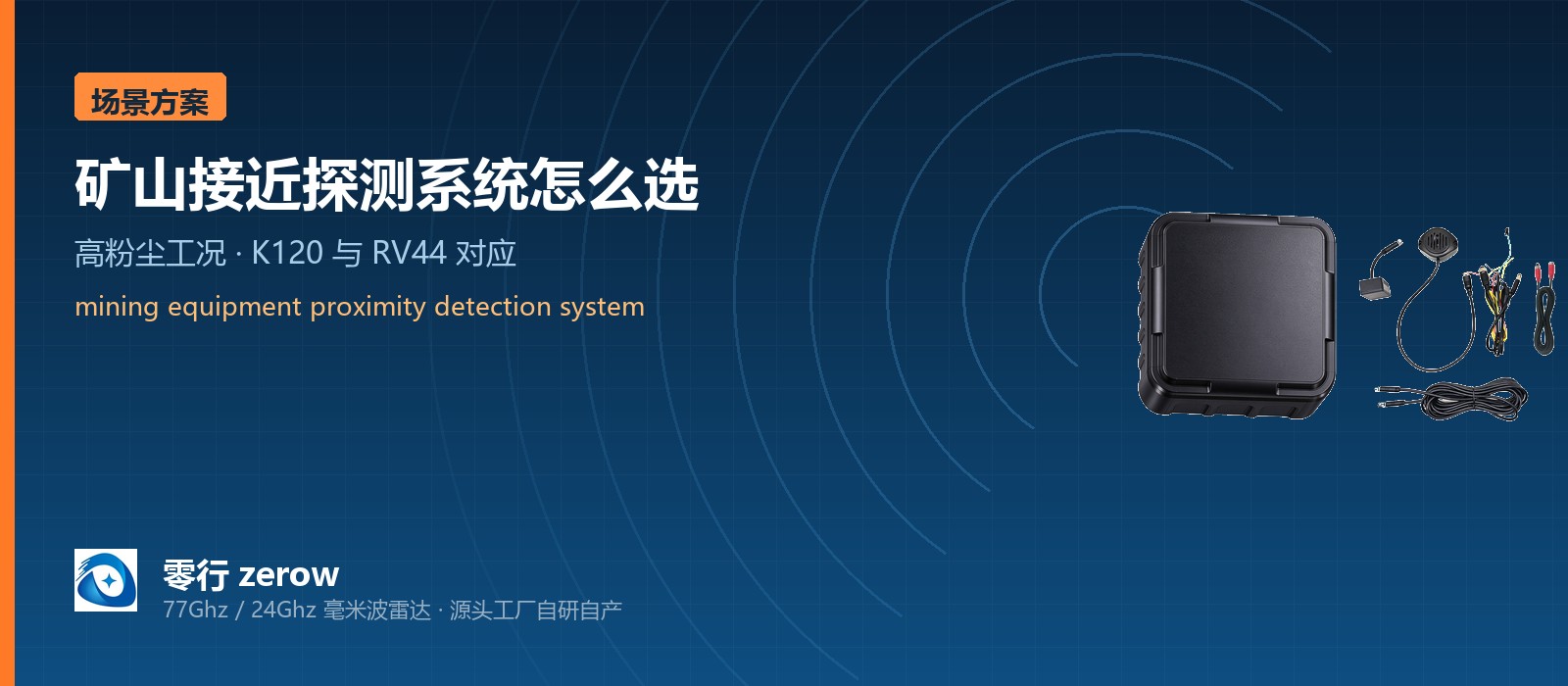
The K120 is the zerow 77GHz millimetre wave radar for long-range forward collision warning. It detects from 0.4 to 120m with an azimuth field of view of plus or minus 60 degrees and an elevation field of view of plus or minus 20 degrees, holds range accuracy within plus or minus 0.4m and range resolution of plus or minus 0.5m, and runs on a 100ms frame period, which is 10Hz, reporting up to 32 targets per frame. For communication and alarms it offers CAN 2.0B with UART/USB, three high-level alarm outputs plus one DI enable, IP67 ingress protection, an operating range of minus 40 to plus 85 degrees Celsius and a supply voltage of 9 to 16V DC, built on the Siversemi Cheetah4401 2T4R radio front end with an Ingenic X2100 processor.
For haul road following, those numbers mean the 0.4m near start leaves no gap, the 120m far end is enough to pick up an oncoming truck or the vehicle ahead around a grade bend, and the 32 target budget is enough to track several vehicles plus scattered people and plant at the same time.
The RV44 is the zerow radar and vision fusion warning system. Its radar operates at 77 to 78GHz with a 40m detection range, a horizontal beam of minus 60 to plus 60 degrees and an elevation beam of minus 5 to plus 5 degrees, 2 transmit and 4 receive channels and a 33Hz refresh rate, with 0.2m range resolution, 2km/h speed resolution and a speed range of plus or minus 60km/h. The radar housing measures 92 by 76.1 by 22.3mm and weighs 109.5g, it is IP67 rated, works from minus 40 to 85 degrees Celsius, draws under 3.5W and takes 12 to 32V DC.
Its division of labour against the K120 is clear: the radar handles dependable detection and alarming, the four 1080P camera channels handle confirmation inside the cab. The video unit runs embedded Linux and supports 4CH 1080P input with downward compatibility, H.264 compression, SD card storage up to 1TB with loop recording, automatic recording on power-up, and a character overlay for time, date, channel name and vehicle ID, plus Bluetooth remote debugging and parameter configuration from a phone APP. The system also carries three IO alarm inputs and one RS485 interface.
Wide-body mine trucks are wide and badly blind, so a single radar cannot cover both flanks at once. The K3-1100 uses a pair of 77GHz radars, one per side, each covering 0.2 to 100m, with a touchscreen host. The graded warning areas are shown in green, yellow and red, up to six detection zones can be configured with an independent range for each, and a CAN interface allows the system to drive automatic braking or a pneumatic valve for active collision avoidance. The single-radar K3-100 offers a 0.2 to 100m length with a configurable detection width and up to three independent zones.
The value of the dual radar is not more range but filling the near-field gaps. At a loading point or on the dump, a radar on each flank means ground workers are covered on both sides while the truck slews, and the graded zones on the screen tell the driver directly whether the hazard is behind-left or behind-right.
This is the step most often missed in mine selection. The K120 supply specification is 9 to 16V DC, so feeding it from a 24V truck system means an external DC-DC converter; the two must not be connected in parallel directly. The RV44 supply range of 12 to 32V DC already covers the common 24V system, which makes it easier to land. The K3 series runs on 12 to 30V, also inside the 24V mine vehicle envelope. On the interface side, CAN 2.0B is the most common choice for talking to the vehicle, UART and USB make on-site debugging simple, and RS485 has the advantage in longer multi-node runs.
The alarm outputs need planning too. The three high-level outputs drive warning lights and horns directly with no intermediate relay board, and the single DI enable can be wired into the vehicle power or the control logic of the body attachment.
As regulatory background, the US Mine Safety and Health Administration has issued both a proposed rule and a final rule on proximity detection systems for mobile machines, covering continuous mining machines along with scoops and coal hauling equipment. The final rule took effect 60 days after its publication in the Federal Register and was phased in over a period of between eight and 36 months.
The technical requirements concentrate on several points. The machine must stop before it comes into contact with a miner. Audible and visual warnings must be given when a miner comes too close. A visual signal on the machine must indicate that the system is functioning properly. The machine must not move if any machine-mounted component is not working, save for limited movement for repair. The system must not interfere with other electrical systems. Installation and maintenance must be carried out by a trained person. The systems the rule refers to consist of machine-mounted components and miner-wearable components.
Pulling the above together: long-range following on the haul road points to the K120, a radar-plus-video setup where the driver needs to confirm the target inside the cab points to the RV44, and frequent people-and-plant crossings with a need for braking linkage points to the K3-1100. The first mistake is reading only the maximum range and ignoring the near start and the angular resolution. The second is assuming radar replaces everything, and skipping the chain from graded warning to human confirmation. The third is believing that fitting the equipment makes you compliant automatically, without case-by-case confirmation of ore body, machine type, duty cycle and installation. zerow can support you on equipment selection, parameter checking and interface planning, and for the final configuration and quotation on a specific truck, contact zerow.