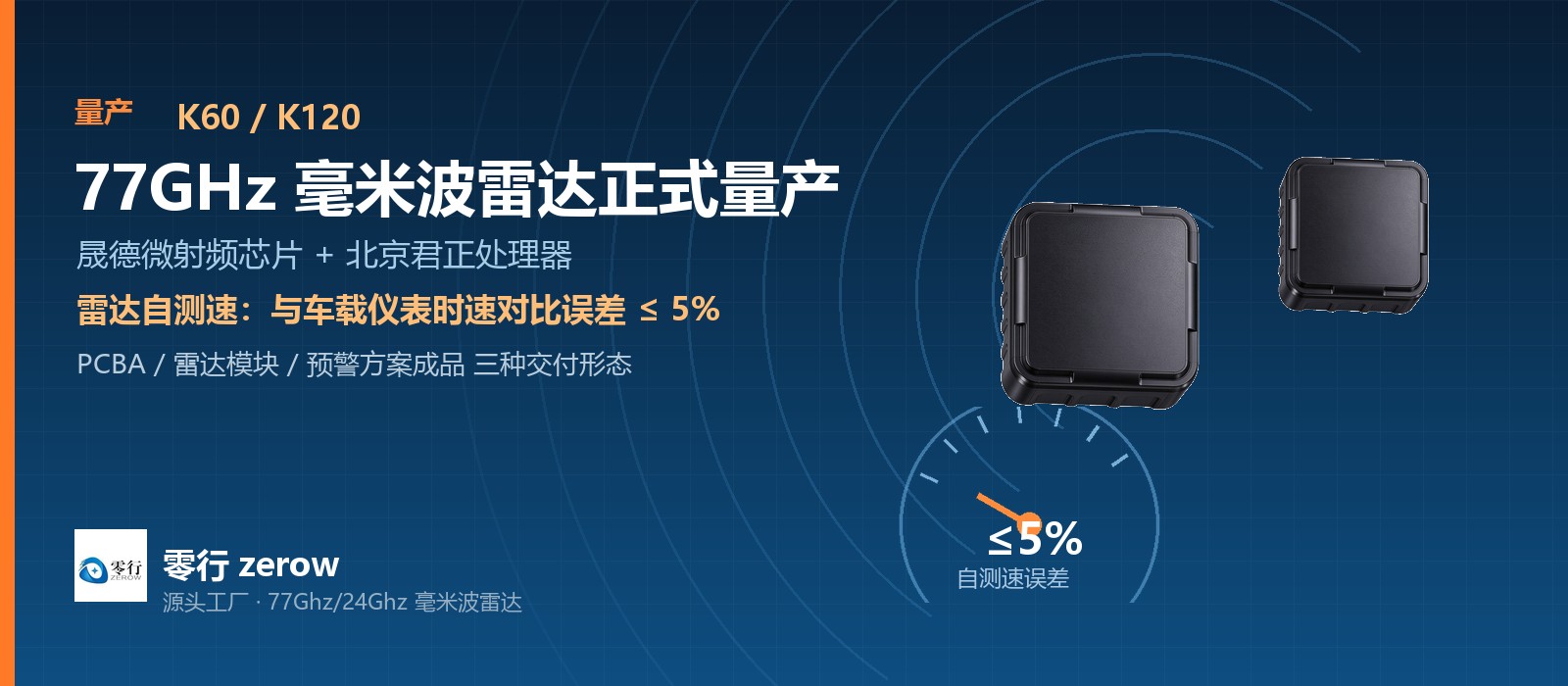
zerow's K60 and K120 77GHz mmWave radars have entered mass production. The production platform uses the Siversemi Cheetah4401 2T4R RF chip and the Ingenic X2100 processor, operating in the 76–81GHz band on a 9–16V DC supply, with IP67 sealing, a -40℃~+85℃ operating range and a 32×32mm module size that stays stable in rain, fog, dust and low temperatures.
Three delivery formats on one production platform
To match different development capabilities and delivery schedules, K60 and K120 are offered in three formats — ready to ship, or integrated by the customer:
- PCBA board: the radar core board (RF front end plus processor) for Tier 1 suppliers and OEMs with in-house product development, who complete enclosure design and system integration themselves.
- Radar module: a 32×32mm IP67 sealed industrial module that can be embedded into a host unit, mirror or bracket; it exposes CAN 2.0B, UART and USB, with 3 positive-trigger high-side outputs that drive beacons and buzzers directly, plus 1 DI enable input.
- Complete warning system: a boxed radar + host unit + display and audible/visual alarm kit, ready to install — the most common form in the aftermarket.
Application scenarios: a clear division of labour
K60 detects 0.2–60m with ±60° azimuth and ±20° elevation, distance accuracy ≤±0.2m, and offers three-zone graded warnings (level 1/2/3) focused on near-field blind spots and three-side collision avoidance:
- Three-side protection for construction machinery: excavators and loaders rotate and travel with pedestrians, two-wheelers and vehicles entering the swing radius at any time.
- Forklifts, AGVs and yard logistics vehicles: low speeds, frequent stops, and a driver view blocked by racking and forks make near-field blind spots the highest risk.
- Commercial vehicle BSD: side and rear blind-spot risks when lorries and coaches change lane or open doors, handled by three-zone graded outputs.
- Low-speed unmanned vehicles and industrial robots: near-range protection for AGVs and autonomous carriers working in mixed indoor and outdoor environments.
K120 detects 0.4–120m with distance accuracy ≤±0.4m and triggers graded alarms through a TTC risk gate, targeting long-range forward collision warning at medium and high speeds:
- FCW for trucks and mining haulers: forward collision warning for lorries and haulers at speed or on descents, where 120m detection gives the driver sight of the risk 100 metres ahead.
- Long-haul highway transport: at high speed, any shortfall in forward warning distance leaves the driver almost no time to react.
- Port tractors and reach stackers: long-range risk detection between heavy port vehicles and fixed structures.
- Road maintenance coordination: cooperative warning between work vehicles, work zones, cones and other site equipment.
Radar self-speed measurement: the other breakthrough in this release
Radar self-speed measurement means the radar uses the Doppler shift of the FMCW signal to measure the relative speed between the vehicle and the ground directly, and derives the vehicle speed from it — no wheel-speed sensor, no GPS, and no CAN speed message required.
In this production release, radar self-speed measurement stays within 5% of the vehicle speedometer. That means it can serve as the speed reference of the warning system itself, rather than a merely auxiliary reading.
Why self-speed measurement matters in the aftermarket
The real obstacle in the aftermarket is rarely whether the radar can be fitted — it is whether vehicle speed can be obtained at all:
- Many lorries, construction machines, two-wheelers and older vehicles have no CAN bus, or their bus protocols are not open enough to parse a speed message.
- Tapping speed from the original dashboard or CAN usually means dismantling and cutting into the vehicle, which damages the vehicle, extends installation time and adds failure points.
- Export markets are even more fragmented: vehicle bus standards and protocol openness differ by country, so a bespoke speed adaptation for every customer inflates both delivery time and after-sales cost.
Radar self-speed measurement removes the speed prerequisite from the system, with very direct benefits:
- Retrofit without touching the vehicle: it runs on power and mounting alone, with far less drilling and wiring, so installation time drops sharply and fleet-wide fitting becomes practical.
- Warning logic works immediately: without speed there is no stationary-target filtering and no TTC, so self-speed measurement keeps graded alarms fully functional on vehicles with no speed signal.
- Universality: the same hardware covers every aftermarket vehicle from two-wheelers to heavy trucks, regardless of differences in electronic architecture.
- No extra sensor cost: speed measurement and detection share the same RF chip and the same signal chain, adding no sensors and no installation cost.
- Fleet and data value: a single consistent speed source for fleets, which can be combined with ADAS logs and event-replay data for safety operations.
For overseas aftermarket customers this means BSD and FCW products no longer need a per-vehicle speed adaptation, shortening delivery and cutting failure rates at the same time. For the domestic aftermarket it means active safety can be upgraded without cutting into the original wiring of the vehicle.
Supply and cooperation
K60 and K120 now accept volume orders in all three formats — PCBA, radar module and complete warning system — and mounting method, warning strategy and output configuration can be tailored to the customer. Contact zerow for samples and the full datasheet.