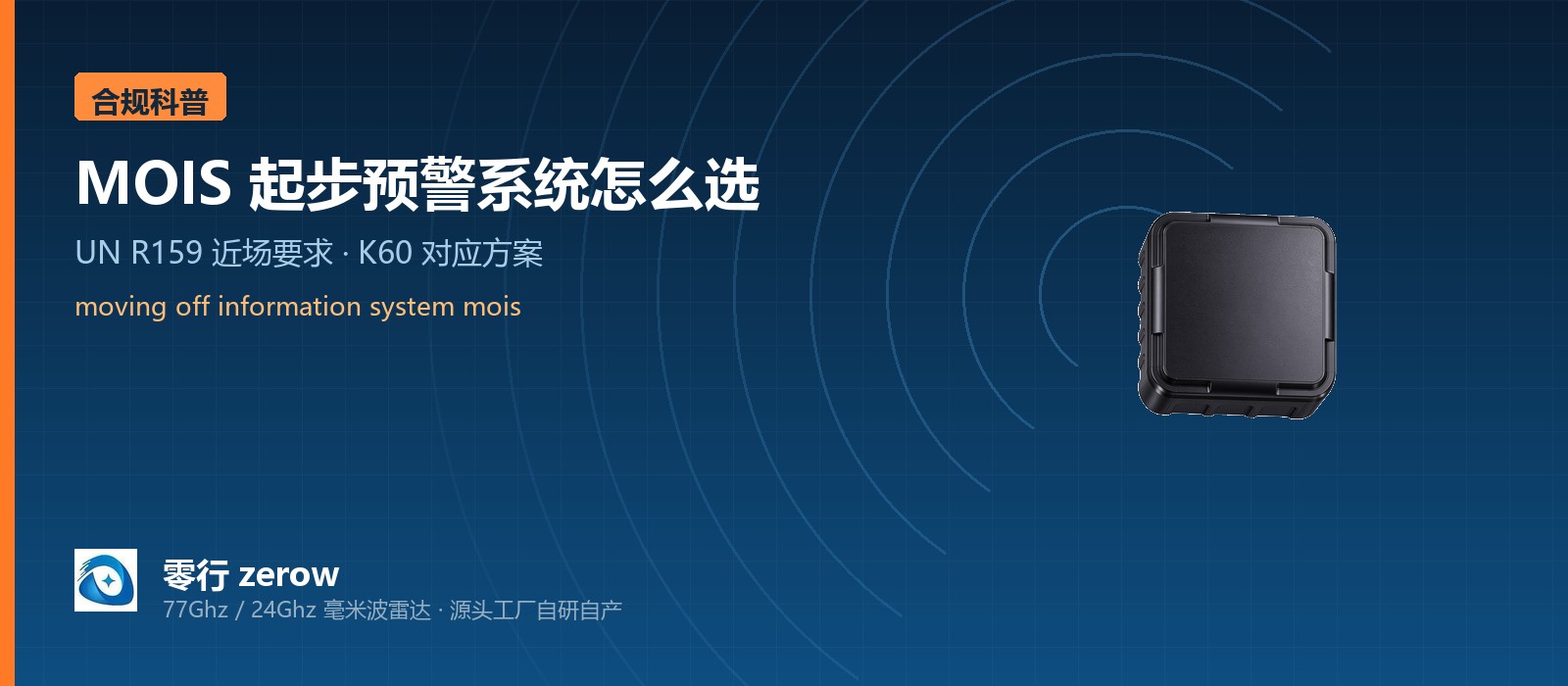
The most dangerous metres for a commercial vehicle are the ones directly ahead when it pulls away, where the driver simply cannot see. The moving off information system mois defined in UN Regulation No. 159 covers exactly that: pedestrians and cyclists in the close front blind spot of a truck or bus, both while it is stationary and preparing to move and while it travels straight below 10 km/h. Unlike the side blind spot regulation, the centre of MOIS is the near field ahead at the moment of moving off, and that changes both the technical approach and how you select hardware.
R159 can be read in three layers. On detection, it has to recognise adult and child pedestrians and adult and child cyclists inside the defined near field. On signalling, the output is graded: an information signal first when a vulnerable road user is present close ahead, and a collision warning signal when the collision risk grows. On operation, it has to cover three vehicle actions, namely standing still with a forward gear selected, moving in a straight line from standstill and slow straight-line travel, with the system working at vehicle speeds below 10 km/h.
R159 applies to M2, M3, N2 and N3 vehicles and entered into force on 10 June 2021. Under the EU General Safety Regulation (EU) 2019/2144, new type approvals in those categories have had to satisfy R159 since 6 July 2022, and newly registered vehicles in those categories have been subject to it since 7 July 2024. Like the side blind spot rules, the regulation is written around right-hand traffic, so left-hand traffic markets need a mirrored configuration.
The MOIS detection area is a box mounted at the front of the vehicle. The minimum forward separation plane sits 0.8 m from the foremost point of the vehicle and the maximum forward separation plane sits at most 3.7 m from it, though it may be set according to the actual blind spot of the model as long as it is not below 1 m. The lateral separation planes depend on the vehicle action: 0.5 m outside the vehicle width for a potential moving-off manoeuvre, and equal to the vehicle width for slow straight-line movement. The minimum detection width requirement is 4.3 m, which means the sensor has to cover a wide band laterally rather than staring at the narrow strip directly in front of the bumper.
R159 also specifies the motion conditions of the vulnerable road users: pedestrians and cyclists crossing at 3–5 km/h, and cyclists travelling in the same direction in the lane at 0–10 km/h, with the system expected to work in ambient light of at least 15 Lux.
One aspect of MOIS that is easy to miss is how sensitive it is to the state of the vehicle. When the vehicle is stationary with a forward gear selected and a vulnerable road user crosses into the detection area, the system must issue the information signal no later than the moment that user crosses the lateral plane; in that case an information signal alone is sufficient and no collision warning is required, because a standing vehicle front does not present the same moving risk. When the vehicle moves below 10 km/h and a cyclist is ahead, the information signal must be issued no later than the moment the user crosses the furthest plane, and if the collision risk continues to grow a collision warning must follow.
For hardware selection that difference matters directly: the response timing in the low-speed case differs from the standing case, so the sensor has to deliver a reliable speed and position decision on a nearly stationary target and still lock on quickly when a target crosses.
R159 requires the system to balance correct detection against erroneous detection and to minimise false alarms, and it sets out three gates that must be passed. The first is automatic deactivation: on a fault, or when the sensor is contaminated by ice, snow, mud or soil, or when ambient light drops below 15 Lux, the system deactivates itself and shows a failure warning signal. The second is manual deactivation: it is allowed through a deliberate sequence of operations such as a double press, but it must not be easy to switch off by accident. The third is recovery, meaning the system returns to operation once the fault or contamination is cleared.
For fleet operators a nuisance alarm remains the number one usability problem. The R159 test methods include static crossing tests, longitudinal moving tests, fault detection tests and automatic deactivation tests, and each of them needs reproducible results behind it.
The K60 is zerow's near and mid-range wide-angle 77GHz mmWave radar, and its published specifications line up closely with what MOIS asks for. The 0.2–60 m detection range covers the 0.8–3.7 m requirement of R159 with margin to spare; the ±60° azimuth and ±20° elevation field of view makes the 4.3 m minimum width straightforward to satisfy with a forward-facing installation; the ≤±0.2 m range accuracy and ≤0.1 m range resolution are enough to separate several targets standing in parallel close ahead; and the 50 ms frame period, that is 20 Hz, is sufficient to lock on to a crossing target.
The first mistake is treating MOIS as forward collision warning. A long-range radar such as the K120 at 0.4–120 m addresses the forward collision risk at highway speeds, while MOIS addresses the near field within a few metres at the moment of moving off, and the two differ in coverage, target type and trigger logic so neither substitutes for the other. The second mistake is assuming that a reversing camera or a forward-facing camera already satisfies MOIS. Detecting low pedestrians and close cyclists ahead demands careful near-field blind spot handling, where cameras are limited by low target height, occlusion and changing light. The third mistake is overlooking how manual deactivation is designed. Allowing a manual switch-off does not mean it can be switched off carelessly, because the regulation requires a deliberate operation sequence.
A sensible order of work for a MOIS-related project looks like this. First fix the mounting position and the forward orientation, because a near-field sensor is sensitive to mounting height and pitch angle. Then settle the signal chain, whether it runs to dedicated lights and a buzzer or into the vehicle network for higher-level logic to trigger. Then confirm how the zone geometry and warning mode are configured, so the standing-start and slow-travel cases can be tuned separately. Finally make the certification responsibility explicit, because the system being part of a type approval and the system being fitted as an aftermarket solution carry completely different owners of the compliance obligation.
UN R159 turns the few metres in front of a starting vehicle into a testable specification window. For a sensor supplier, the most valuable contribution is to turn near-field coverage, target separation and failure behaviour into quotable numbers, and to stay honest about the certification boundary: what zerow has already achieved, and what every vehicle manufacturer and test laboratory still has to confirm case by case.