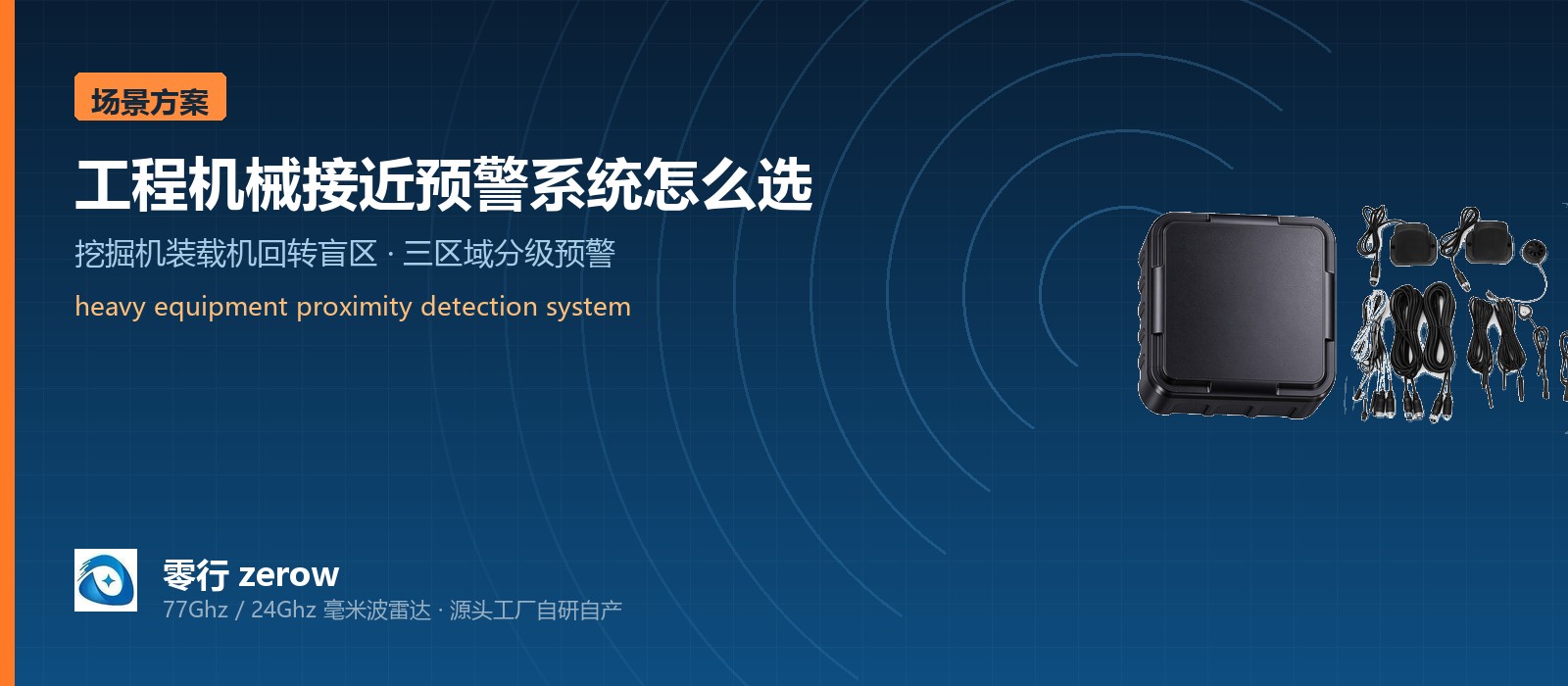
Excavators, wheel loaders and wide-body mining trucks do not take their biggest risk head-on — they take it from the side they cannot swing around to. A pedestrian inside the slew radius of a 20-tonne excavator, an electric bike appearing behind a loader in reverse: these are situations that are currently covered by operator experience, and a single miss is a single accident. Getting a handle on that means the core question is not which radar model to buy, but how far and how wide a heavy equipment proximity detection system has to reach, and how the warning has to be graded. zerow's K60, K20 and RV44 cover three typical deployment shapes. Here they are, parameter by parameter.
A loader or excavator has a working radius far larger than its own body, the operator sits off to one side, and the right-hand and rear sectors are structurally blind. A loader shuttling back and forth between a stockpile and a batching plant reverses far more often than any road vehicle, and every reverse is a separate collision window. So heavy equipment proximity warning does not have to answer whether a target can be detected; it has to answer how early the target is detected, while there is still time to see it and react.
Equipment inside a plant rarely travels at road speeds, but it is heavily loaded, it brakes late, and the operator is often seated where the view is obstructed. When the range falls short, the target is already inside the collision envelope by the time the alarm sounds.
The zerow K60 detects over 0.2~60m with a range accuracy of ≤ ±0.2m, a range resolution of ≤ 0.1m, a 50ms (20Hz) frame period and up to 64 targets per frame. That 0.2m near-field start means the radar is already working almost against the bumper, so mounting it at the rear or on the flank leaves no dead zone where a target is simply too close to see.
The angle decides what the radar covers depending on where on the body it sits and which way it faces. The K60 offers ±60° azimuth and ±20° elevation, and on heavy equipment it is normally mounted at the rear quarter or directly behind the vehicle, where ±60° azimuth covers the pedestrian walkway alongside the body. The K20 carries ±60° horizontal and ±60° elevation beamwidth, close to hemispherical coverage, which suits a front-mounted or under-the-fork position. The RV44 radar runs ±60° horizontal with -5°~+5° elevation — a wide horizontal, narrow vertical scan, right for watching forward or one specific direction.
The thing a worksite fears most is not a missing alarm, it is an alarm so frequent that the operator goes numb and starts treating the horn as background noise. The K60 uses three-zone graded warning (alarm level 1/2/3), triggering different output levels by target distance, so the light comes on at range and the horn only sounds up close. The K3 series hosts use green/yellow/red warning zones to separate far from near, and the warning mode can be switched between all and approach only.
The last mile of a warning system is how it makes itself heard. The K60 provides 3× high-level plus 1× DI alarm output, which drives warning beacons and horns directly with no additional relay board required. On the communications side it offers CAN 2.0B + UART/USB, so it can join the vehicle network to pick up signals such as road speed and can also be connected to a configuration host for commissioning. The RV44 host adds 3 IO alarm inputs and 1 RS485 interface.
Cameras in plants and mines have two problems that are hard to design around: dust and fog attenuate visible light, and at night or against backlight the target's features wash out. A 77GHz millimetre-wave radar works across a 76–81GHz operating band, does not depend on ambient light, and is not blocked by visible-light conditions, so it keeps working in heavy rain, dust and low temperature. This is not radar being superior to cameras; the two answer different questions. Radar answers whether something is there, how far and how fast. The camera answers what it is.
The K60 is the general-purpose answer: a module form factor, 9~16V DC supply, IP67 sealing, -40℃~+85℃ operation, built on the Siversemi Cheetah4401 2T4R RF chip and the Ingenic X2100 processor, reporting up to 64 targets per frame, with a range and angle envelope that covers the vast majority of three-side protection duty on heavy equipment.
The K20 is the compact route: 40×40×24.5mm, 9~24V, 76–77GHz, 3TX4RX, 2.5W power consumption, with two-stage voice broadcast, adjustable volume and customisable voice content. It suits tight installations under the fork or at the tailgate, and equally suits AGVs and sanitation vehicles.
The RV44 is a radar-plus-video fusion system: an embedded Linux host with a 4-channel 1080P H.264 video unit, SD card storage up to 1TB, and APP Bluetooth remote debugging and parameter configuration, with the radar body at 109.5g so it can be mounted away from the cameras. It covers patrol robots, mining machinery, special-purpose construction equipment, unmanned boats, agricultural machinery and airport shuttle vehicles.
Work through four steps. First, confirm the working radius and the highest travel speed, then work backwards to the minimum detection range required. Second, confirm the mounting position and orientation, and fix the azimuth and elevation you need. Third, confirm which supply family the site runs on — 9~16V, 9~24V or 12~32V — and pick the matching model. Fourth, confirm how many beacons and horns the alarm has to drive, and match that against the number of outputs. Where the site also needs active braking or a pneumatic valve interlock, the K3 series hosts can go further through the CAN interface for active avoidance.
For a firm quotation, interface documentation or sample testing, contact us for the detailed specifications and a selection recommendation for the specific model.