The most dangerous machine in a warehouse is rarely the fastest one; it is the one that starts and stops most often. A forklift weaving between racks may average seven or eight kilometres an hour, yet it makes thousands of starts, stops and turns in a shift, and every start is a moment where the forks and load swing out. Racking makes it worse. Standing at the seat, a two-metre-tall rack hides the entire aisle ahead, and columns, pallets and stacked empty frames create fresh blind spots every time the layout shifts. Pedestrians walk into exactly those gaps. That is why a forklift pedestrian detection system has become a fixed line item on warehouse safety purchase lists rather than an option.
Strip forklift incidents down and three scenarios repeat: a pedestrian walking alongside while the forklift reverses or turns out of a rack; someone crouching to pick up goods directly in front of the mast; and a person stepping out from the side of a load at the exact moment the truck pulls away. In all three, each party assumes the other will see them first.
A forklift works in a small radius, but racking is tall and stacked irregularly, and pedestrians often appear from less than a metre away. Too far and you cannot tell who it is; too near and there is no room to brake. That makes the near-field start more important than the far-end reach.
The zerow K60 detects over 0.2~60m with a range accuracy of ≤ ±0.2m, a range resolution of ≤ 0.1m, a 50ms (20Hz) frame period and up to 64 targets per frame. The detection angle is ±60° azimuth and ±20° elevation, close to hemispherical coverage, so narrow rack aisles and the area directly in front of the mast both fall inside the beam. The 0.2m near-field start means the radar is already working almost against the bumper, which is precisely the coverage a forklift needs under the mast and in the gaps between racks.
The most common way a forklift alarm fails is not a broken unit; it is the driver who works in a permanently sounding environment and classifies the noise as background the moment it becomes habitual. Once that habit forms, a brand-new system gets treated the same way. Graded warning restores information content to the sound itself.
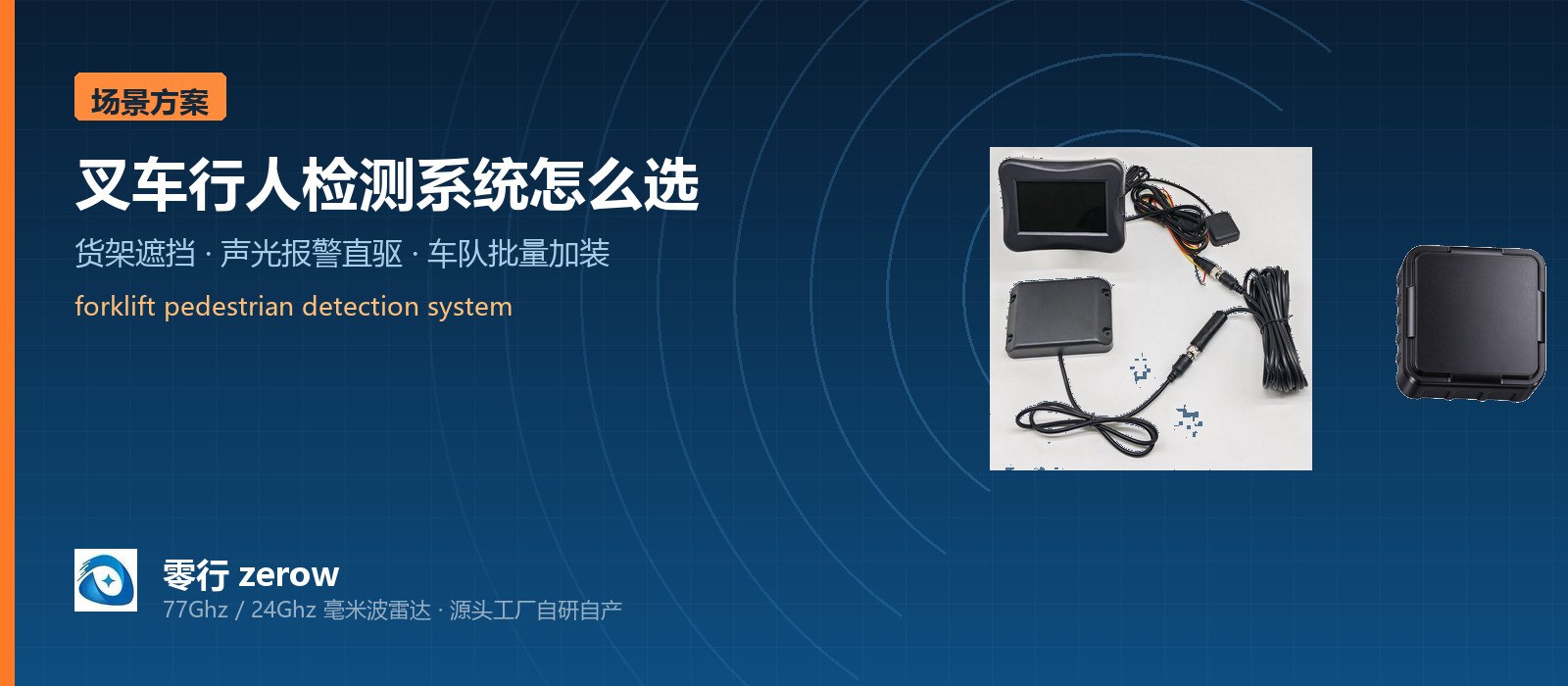
The K60 uses three-zone graded warning (alarm level 1/2/3), triggering different output levels by target distance, so the light comes on at range and the horn only sounds up close. The K3 series hosts use green/yellow/red warning zones to separate far from near, with the warning mode switchable between all and approach only. The K10 kit ships as 3 24GHz radars plus 1 sound-and-light alarm unit plus 3 red beacons and a harness, with 30W beacons (6 LEDs each), giving synchronised audible and visual alarms.
The alarm devices on a forklift are external. The beacon sits on the guard or above the seat, the horn sits on the frame, and between them sit cables, power and weatherproofing. The output interface decides how hard the installation is.
The K60 provides 3× high-level plus 1× DI alarm output, driving warning beacons and horns directly with no additional relay board. On the communications side it offers CAN 2.0B + UART/USB, so it can join the vehicle network for signals such as road speed and can also be connected to a configuration host. That matters for retrofit work in particular, because existing forklifts often have no usable CAN speed message to offer, and a radar that measures ego speed and works standalone is more practical than one that has to join the bus.
Cameras in a forklift work area have two structural weaknesses. First, racks, pallets and cartons create heavy visual occlusion, and detection quality drops sharply when a target shows only half a body. Second, warehouse dust, floor reflections and backlight weaken the image further. More fundamentally, when a forklift reverses, the camera is at the tail while the target is under the mast, so the angles do not even correspond.
A 77GHz millimetre-wave radar works across a 76–81GHz band, does not depend on visible light and is not blocked by racking, and it measures distance and relative speed directly. The K60 production platform operates in the 76–81GHz band with IP67 sealing and a -40℃~+85℃ operating range; the K3-100 and K3-40 work in 77–78GHz with IP67, a 33Hz refresh rate and the same -40℃~+85℃ coverage.
A common warehouse practice is to fit a blue beacon on the forklift so people nearby notice the vehicle. That device works for what it is, but it solves the problem of telling others to watch out for me, not the problem of me watching out for others. When a forklift reverses, turns a narrow aisle or pulls away from the rack, a blue light only warns pedestrians who are already looking at the truck, while the real danger is the pedestrian hidden behind racking a metre away — exactly the case the blue light cannot reach.
For a customer covering dozens or hundreds of forklifts, the practical question is not the performance of a single unit, but installation and maintenance cost across the fleet.
The lightest approach is the K10 kit: 24GHz, 1TX2RX, DC 9~24V, an operating current of 20~30mA, a plastic housing with no metal obstruction, detection of moving objects only, ±50cm ranging error, and a test standard of human walking speed at 0.3~1m/s. The kit contains 3 radars, 1 sound-and-light alarm unit and 3 red beacons, and operates from -20℃~+60℃. It detects moving objects, which is exactly the pedestrian and the moving truck.
The standard approach is the K60 module: 9~16V DC supply, IP67, -40℃~+85℃ operation, built on the Siversemi Cheetah4401 2T4R RF chip and the Ingenic X2100 processor, reporting up to 64 targets per frame, with a range and angle envelope that covers the full perimeter of the vehicle.
Where a host with visualisation is wanted, go with the K3-100 or K3-40: 12–30V supply, 2TX4RX, 33Hz refresh rate, three-level warning zones, a touchscreen host and configurable detection zone distances. The K3 series can also drive automatic braking or a pneumatic valve through the CAN interface for active avoidance.
Five steps. First, survey the aisle width, the rack height and the positions where incidents actually happen, and use that to fix the detection range and angle. Second, confirm the supply family: DC 9~24V for the K10, 9~16V for the K60 and 12–30V for the K3 series. Third, confirm how many beacons and horns the alarm has to drive and match that against the number of outputs. Fourth, confirm whether a touchscreen host and visual zone calibration are required. Fifth, confirm whether automatic braking or a pneumatic valve interlock is wanted for active avoidance.
For a firm quotation, interface documentation or sample testing, contact us for the detailed specifications and a selection recommendation for the specific model.