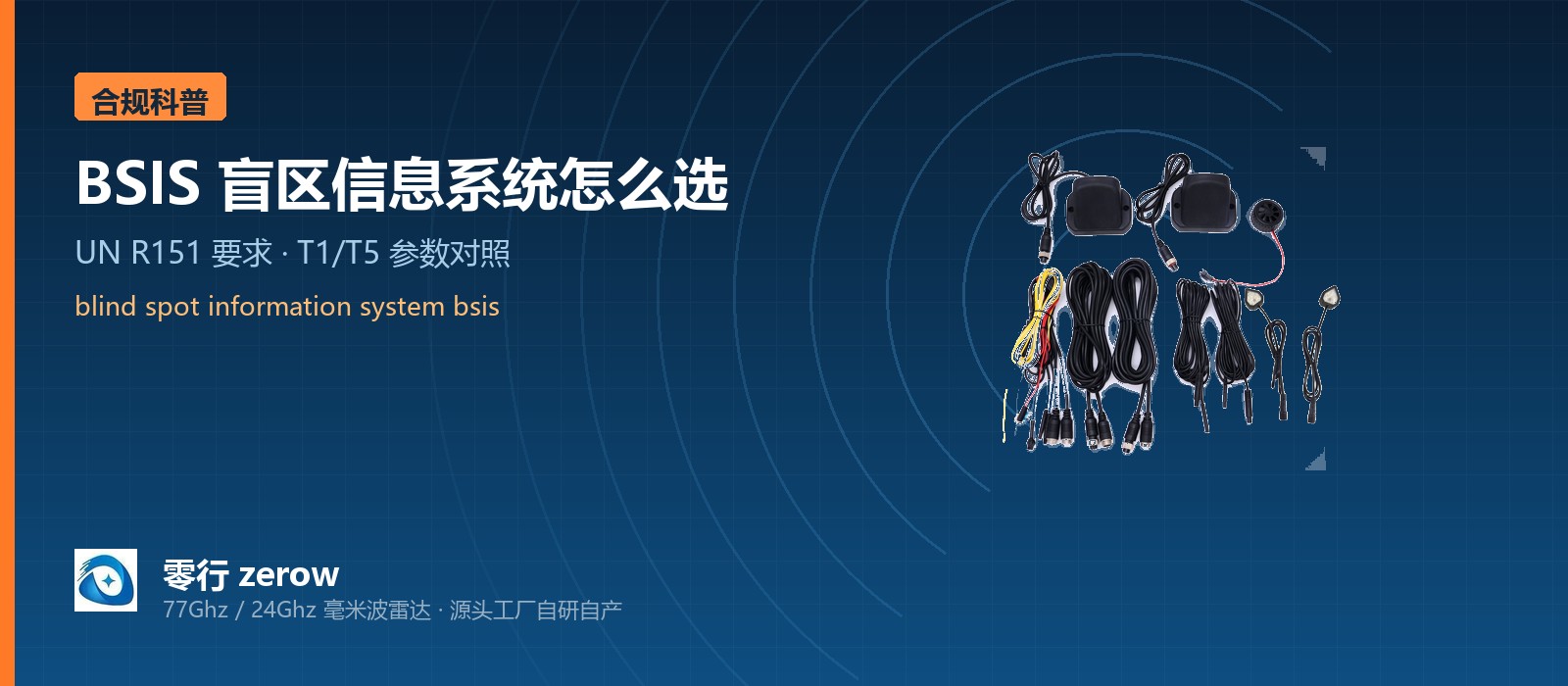
In the European commercial-vehicle market, blind spot information system bsis is not a marketing phrase. It maps directly to UN Regulation No. 151, which makes bicycle detection in the right-hand blind spot of M2, M3, N2 and N3 vehicles a type-approval requirement. For teams selling or retrofitting BSD systems into trucks and buses, understanding where R151 starts and stops matters more than any feature list: the regulation fixes the detection area, the two-stage warning logic and the false-alarm expectations, and it is equally clear about which responsibilities stay with the vehicle manufacturer.
R151 (the uniform provisions concerning the approval of vehicles with regard to the blind spot information system for the detection of bicycles) can be read as three requirements. The system must detect vulnerable road users (VRU) in the right-hand blind spot of the vehicle, cyclists being the primary target while pedestrians moving at 1–10 km/h are also covered. The warning must be graded, starting with a low-intensity information signal and escalating to a warning signal as collision risk grows. And the system must be self-diagnosing: when the sensor is blocked by ice, snow or mud, or a fault occurs, it deactivates automatically with a visible indication and reactivates once the sensor is clean.
R151 covers N2 and N3 goods vehicles and M2 and M3 passenger vehicles. Under the EU General Safety Regulation (EU) 2019/2144, new type approvals in those categories had to satisfy R151 from 6 July 2022, and all newly registered vehicles in those categories have been subject to it since 7 July 2024. The regulation is written around right-hand traffic, so left-hand traffic markets need the sensing direction mirrored, which is one reason installation parameters differ between European countries.
R151 does not reward maximum range; it fixes a box. Measured from the vehicle's right front corner, the detection area extends 0.9–4.25 m laterally and −0.6 to +0.6 m longitudinally relative to the front axle centre. A cyclist riding at 5–20 km/h has to be recognised, and the system is expected to work at vehicle speeds of 5–30 km/h in ambient light of at least 15 Lux. A stationary vehicle must also detect a cyclist approaching from behind.
For anyone selecting hardware, that produces a clear ranking: angular accuracy and a gap-free near field matter far more than headline range. A sensor that reaches 50 m but leaves a hole at 1 m is the wrong part for this regulation.
The graded logic matters most for retrofit programmes. The information signal is given when a bicycle enters the potential collision area within 6 m of the vehicle's right front corner; it is predominantly optical and tells the driver that something is there, rather than demanding an immediate brake application. The warning signal comes when collision risk increases, for example when the driver indicates a turn, and may combine optical, acoustic or tactile means. Timing is constrained too: the earliest information point is defined as the last information point plus four seconds of travel, so the alert has to arrive early enough to still be actionable.
For a fleet operator a nuisance alarm is worse than a missed alert, because a driver warned for nothing twice will switch the system off. R151 therefore requires false-alarm suppression for static objects such as vegetation, guardrails, bollards, advertising boards and traffic signs, and it includes fault-detection and automatic-deactivation tests in the approval procedure.
zerow's 77GHz BSD product line can cover the close-range side areas R151 focuses on. The boundary should be stated plainly: type approval is a verdict on the complete vehicle, granted by the manufacturer together with a test laboratory. What zerow supplies is sensing hardware and the warning system, and whether a specific vehicle model passes R151 has to be confirmed case by case for that model.
The first mistake is assuming that bolting on a camera mirror equals compliance. R151 grades the detection area, the warning escalation, the failure handling and the false-alarm suppression, not whether the vehicle carries some kind of prompt. The second mistake is treating maximum detection range as the compliance argument. What the regulation cares about is detection inside the 0.9–4.25 m lateral band and the timing of the response, so 50 m is the top of the scale rather than the passing grade. The third mistake is assuming an aftermarket radar can certify itself. Type approval is a vehicle-level conclusion reached with a test laboratory; the supplier's job is to provide a sensor and a system that meet the requirement.
A sensible order of work for any R151-related project looks like this. Start from the vehicle: establish where the right-hand blind spot really sits on the combination, and check that the sensor does not push the vehicle more than 100 mm beyond its width. Then define the interface, whether the alarm is delivered by lamps and a buzzer, forwarded as CAN messages into the vehicle network, or has to coexist with an existing reversing camera system. Ask the supplier for numbers rather than adjectives: detection area, response timing, deactivation and recovery behaviour, protection rating and operating temperature. Finally, make the compliance route explicit, because a system built into a type approval and a system fitted as an aftermarket retrofit carry completely different responsibilities.
R151 writes a clear floor for side blind spot safety, and it does so in text that can be tested. For a sensor supplier such as zerow, the most valuable contribution is to turn detection capability, warning grading and failure behaviour into verifiable parameters that can be quoted in a datasheet, while staying honest about the certification boundary: what zerow has already achieved, and what every vehicle manufacturer and test laboratory still has to confirm case by case.