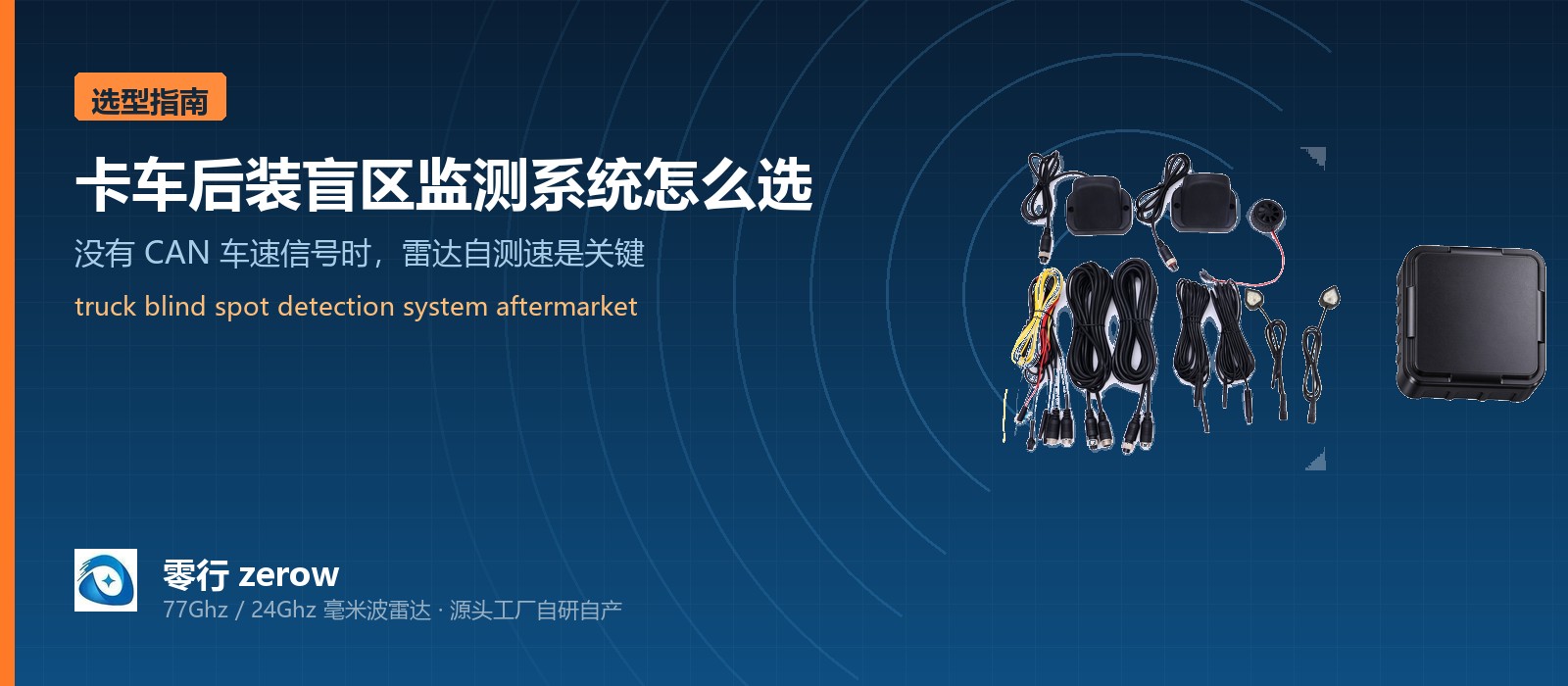
Retrofitting a truck that is already on the road with a blind spot detection system is rarely blocked by the radar itself. A 12-metre flatbed, an old tipper, a tractor unit bought second-hand — they all share one problem: there is no usable CAN speed message, or the bus protocol is closed enough that vehicle speed cannot be read. So when procurement teams search for a "truck blind spot detection system aftermarket", what they are really looking for is a package that installs without dismantling the vehicle, without cutting into the original wiring, and that actually works once fitted.
The short version: three dimensions decide the outcome
Strip a retrofit blind spot system down and only three things decide whether the project ships:
- Can the detection performance match the vehicle weight and speed: detection range, range accuracy, horizontal coverage
- Where the speed reference comes from: without a speed signal, does the warning logic still hold
- What does the installation cost: supply voltage range, whether the original wiring must be cut, whether fleet-wide fitting is practical
Many projects stall on the second point. The radar is fitted, but with no speed input there is no stationary-target filtering and no TTC calculation — half of the warning logic simply does not exist.
Why the speed signal is the first hurdle in the aftermarket
In a new vehicle, speed normally comes from wheel-speed sensors or a CAN message, and a head unit simply plugs in. The aftermarket is a different world:
- Many lorries, tractors, construction machines and older vehicles have no CAN bus at all, or a protocol that cannot be parsed for speed
- Tapping the original dashboard or CAN usually means dismantling and cutting, which damages the vehicle, lengthens installation time and adds failure points
- Export markets are more fragmented: vehicle bus standards and protocol openness differ by country, so a bespoke speed adaptation for every customer inflates both delivery time and after-sales cost
In other words, whether you can read vehicle speed decides whether the system is genuinely usable or just decoration on the truck.
Radar self-speed measurement removes that hurdle entirely
The principle is straightforward. While an FMCW radar is detecting targets, the echo already carries a Doppler shift related to the vehicle's own motion. Measuring the relative speed between the vehicle and the ground yields vehicle speed directly — no wheel-speed sensor, no GPS, no CAN speed message.
On zerow's mass-production 77GHz radars, the self-measured speed stays within 5% of the dashboard speedometer. That number matters: it means the radar speed can serve as the speed reference of the warning system itself, not merely an auxiliary reading.
Take the T5 as an example: its specified speed measurement range is ±200km/h with 0.2m/s speed resolution, covering the real speed band of heavy trucks and articulated combinations. The same radar performs side and rear target detection and ego-speed measurement — no extra sensor, no extra installation cost.
Dimension one: match range and accuracy to vehicle weight and speed
Heavy trucks travel fast and brake long; when detection range falls short, the reaction time left to the driver is extremely thin. Real specifications from the zerow commercial-vehicle range:
- T1 truck and bus blind spot and lane-change assist terminal: 77GHz, 50m detection range, range accuracy better than 0.18m, 0.5m range resolution, BSD / LCA / AOA in one unit
- T5 truck and bus blind spot and lane-change assist radar: 77GHz, 50m detection with a single radar plus 10m real-time rear warning, ±55° horizontal and ±25° elevation beamwidth, range accuracy better than 0.2m
- H1 blind spot and lane-change assist system: BSD / LCA / AOA / RCTA four-in-one, a 2-radar kit with indicator lights and buzzer, up to 50m, computing speed, angle and relative displacement for up to 32 targets simultaneously
When selecting, do not look only at the headline maximum range — ask which direction that range covers. Side and rear BSD and forward FCW are entirely different jobs.
Dimension two: supply voltage and installation cost
The worst outcome in a retrofit is having to cut into the vehicle's structure after the radar is installed. zerow's automotive-grade radar specifications cover most truck platforms:
- Wide voltage input: 9–36V on the T5, 9–16V on the H1, 12–32V on the T1 and 14–32V on the K5, covering common 12V and 24V systems
- Modest power draw: under 3W for the H1 and T1, under 6W at full load on the K5 — no need for a major power-supply rework
- Environmental headroom: -40℃ to +85℃ operating temperature and IP67 sealing for northern winters, southern rainy seasons, spray and grit around the axles
- Compact packaging: the T5 housing is only 28×28×22.5mm, so it can hide in a roof rack, behind a mirror or inside a mudguard without eating cab space
Dimension three: the feature set decides the warning logic
Radar is radar, but the combination of features determines which driving scenarios are covered:
- Side and rear BSD / LCA: lane changes, door opening and merging — the T1 and T5 represent this class
- Four-in-one BSD / LCA / AOA / RCTA: the H1 brings rear cross traffic and door opening into the same system, well suited to urban delivery and port vehicles
- Configurable detection zones: the K3 series offers 0.2–100m with limitable detection width and up to three configurable zones per radar, matching the working radius of airports, ports and construction machinery
- Forward FCW with TTC: the K5 reaches 100m, displays obstacle distance, vehicle speed and TTC on a touch screen, and exports GPS and TF-card logs for incident review
On a typical long-haul fleet the common approach is FCW at the front plus BSD/LCA at the sides and rear — two sensor sets covering different risk surfaces, rather than one device doing everything.
On the regulations: what BSIS actually requires
In the European market, UN R151 makes a blind spot information system (BSIS) mandatory for goods vehicles above 8 tonnes, while UN R158 covers rearward detection for reversing and right turns (REIS). Procurement teams often blur the line between regulation and product selection, so two clarifications help:
- Regulations care about whether the system covers the required zones, when it warns and whether false alarms are prevented — not about a particular brand
- What zerow provides is the technical capability matching those functional definitions plus complete datasheets; whether a specific batch satisfies a given compliance requirement must be confirmed case by case against vehicle type and the local authority
So when you request a quote, listing your vehicle types, gross weight, typical routes and existing electronic configuration is far more productive than asking whether a product is "certified".
Common questions
- Can it be fitted to an old truck with no CAN? Yes — that is exactly why self-speed measurement exists. Give it power and the radar derives vehicle speed itself, so the warning logic works.
- Does the original wiring have to be cut? No. The radar only needs 12V or 24V and a mounting point; the cable run can be planned independently.
- Does it still work in rain, fog and at night? 77GHz millimetre wave attenuates far less in rain and fog than visible light or laser, and it does not depend on ambient light at night; with IP67 sealing it keeps working in harsh conditions.
- How many false alarms? Multi-zone graded warning — green/yellow/red or levels 1/2/3 by distance — is the basic means of suppressing nuisance alarms, and zone distances are configurable on the host unit.
- How many vehicles can be fitted? The same specification covers fleet-wide fitting from 12-metre flatbeds to articulated tractors, with mounting method and warning strategy adjustable per vehicle type.
What zerow offers
zerow is a source factory for millimetre-wave radar, developing and producing its own 77GHz and 24GHz RF platforms. Production uses the Siversemi Cheetah4401 2T4R RF chip and the Ingenic X2100 processor across the 76–81GHz band.
For aftermarket customers we supply three delivery formats: the radar PCBA board (for Tier 1 suppliers and OEMs with in-house product development), the sealed radar module (ready to embed in a host unit or bracket), and the complete radar + host unit + display and audible/visual warning kit.
If you are looking for a blind spot detection system aftermarket package for a fleet or a batch of older vehicles, send us your vehicle list and supply specifications and we will recommend a configuration and samples for your actual duty cycle.